Introduction
Coronary angioplasty for chronic total occlusion
(CTO) is now called “Last frontier in PCI”. In this field,
many Japanese doctors have done a lot of works. They are
Drs. Osamu KATO, Hideo TAMAI, Takahiko SUZUKI, my friend
Kazuaki MITSUDO and others. I myself also published an article
regarding PCI for CTO lesions in 2003 on the journal of
“Catheterization and Cardiovascular Intervention” (Saito
S, Tanaka S, Hiroe Y, Miyashita Y, Takahashi S, Satake S,
Tanaka K. Angioplasty for Chronic Total Occlusion by Using
Tapered-Tip Guidewires. Catheter and Cardiovasc Interv 2003:
59; 305-11).
Recently many foreign doctors also are getting interested
in PCI for CTO lesions. Cardiology Research Foundation (CRF),
which is run in U.S.A. by a group of Drs. Martin Leon, Gregg
Stone, Issam Moussa, Jeffrey Moses, Antonio Colombo and
other famous doctors, started an annual small live demonstration
course focused only on PCI for CTO lesions since last year.
This year, it was held on February 4 and 5 in New York City,
and I was invited as one of the invited operators and lecture
Presentators.
The name of the meeting was “2nd International Chronic Total
Occlusion Summit”. Everybody called it shortly as “CTO Summit”.
The live cases were transmitted from Columbia University
Medical Center, New York City, where the former President
of U.S.A., Bill Clinton had coronary bypass surgery.
February 3 Thursday, 2005
I took a flight to New York from Narita by
JL006 departing around 11:00 AM on February 3. The flight
from Narita Airport to New York John F. Kennedy International
Airport takes about 12 hours. Since there is 14 hours' time
difference between Tokyo and New York, the flight arrived
at N.Y. Airport around 9:00 AM on February 3. Unfortunately,
the network system for the immigration control at the airport
was down, it took more than 1 hour to pass through the immigration
control. John F. Kennedy Airport is located about 40 KM
far from the downtown N.Y. in Manhattan Island. The traffic
to the downtown was heavy due to road construction. I checked
in the hotel Grand Hyatt around 11:30 AM, where the meeting
was also held.
Next to Grand Hyatt Hotel, there is New York Central Train
Station. Within the station, there is a famous seafood restaurant
“Oyster Bar”, whose branch is also in Shinagawa Station
in Tokyo. After checking in the hotel, I went to this restaurant
to have lunch.
Since I had only very short sleep during the coming flight,
I got sleepy and had short sleep for 2 hours in my room.
I have friend doctors in New York City. They are Dr. John
Coppola as well as Dr. Kwang in St. Vincent Medical Center.
We had a small live demonstration course dedicated to TRI
within the hospital last March. It was successful, and I
performed several cases. Since there is strong competition
among several Medical Centers in N.Y. especially in the
field of Interventional Cardiology, I frankly had spoken
to John that I would do live case at Columbia University
Medical Center during CTO Summit. He kindly understood my
situation and proposed me to have dinner together.
I went to an Italian Restaurant “Gonzo” near St. Vincent
Hospital at 6:30 PM, where already John and other doctors
were waiting for our arrival. We had wonderful dinner together
in this nice Italian restaurant Gonzo.
After finishing the dinner, we Japanese group
went to a famous Japanese noodle restaurant, which is run
by the wife of one of my patients in Kamakura. Fortunately,
he was just visiting N.Y. at the same time, and I could
see him. He proposed me to take us to nice restaurants and
bars on Saturday, which only the residents in N.Y. could
know. I accepted this proposal, and came back to the hotel.
February 4 Friday, 2005
Because of severe jet lag, I waked up at 4:00
AM. I prepared for my presentation titled “Why to Prefer
(and How to Use): Miracle Bros and Magic Wires”. That presentation
was scheduled from 11:25 AM on the day.
I went down to a small meeting room at 7:00 AM, where some
pre-meeting for speakers was planned. However, as I expected,
there was no body in the room. I went to the lobby restaurant
to have a light breakfast and came to the meeting venue
by 7:30 AM, which was a ball room on the 3rd floor of the
hotel.
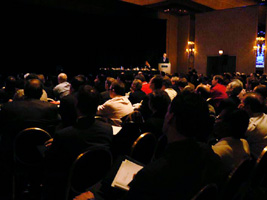
The meeting was started from 7:45 AM by the introductory
speech by Dr. Gregg Stone. Following his speech, we had
nice educative lectures. The meeting venue was very crowded
. I was very surprised to see those intimate doctors from
the world as Drs. Eulogio Garcia, Fina Mauri, SJ Park, Runlin
Gao as well as Junbo Ge.
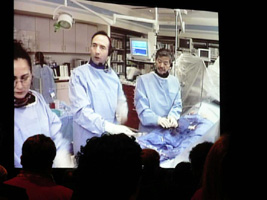
The live case transmissions were started from 9:00 AM. There
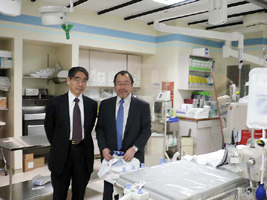
were 4 operators including Dr. KATO and Dr. SUZUKI. Dr.
KATO successfully opened a CTO in the middle RCA. Dr. SUZUKI
fought a hard CTO in the proximal LAD for more than 4 hours
but unfortunately not succeeded.
| |
|
During the Meeting |
Dr KATO doing
a Case |
After these live transmissions, I finished
my presentation shrewdly. Since it was already lunch time,
we moved to another Japanese noodle restaurant and had lunch.
In the afternoon, we also had live case transmissions and
lectures on new devices for CTO: ILT Safe-Cross System and
LuMend FrontRunner Catheter.
Because I was supposed to have my own live transmission
next morning, I decided to have dinner early. I cancelled
to join the faculty dinner at that night and went to a Sushi
restaurant. After finishing this Sushi restaurant, we went
to a Japanese Ramen restaurant. Japanese Ramen is now very
popular in New York City. Thus, I had great anticipation.
However, I was really disappointed for the taste. Japanese
Ramen has already been too much popular in this city, so
that its taste is now not Japanese taste.
February 5 Saturday, 2005
I was asked to come down on the 3rd floor
at 7:00 AM to go to the hospital. The CRF foundation arranged
me a limousine car. I went to the hospital by using this
car. Since it was Saturday, the traffic was very light.
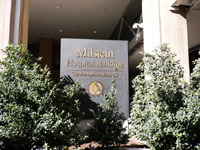
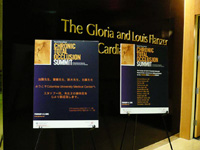
I arrived at the Presbyterian Hospital Building of Columbia
University Medical Center in 20 minutes. At the entrance
of the Interventional Cardiology Section, there was a signboard
welcoming us. The section is controlled by Dr. Jeffrey Moses
and now has 8 catheter laboratories. They have 3 Japanese
Research Fellows including Dr. Ken-ichi FUJII from Hyogo
Medical College.
| |
|
Hospital Signboard |
| |
Hospital Building |
Welcoming Us |
In that morning, live case operators included
Dr. MITSUDO, Dr. Nicolaus J. Reifart from Germany and I.
They sent me CDs for 2 patients. Both cases had long CTO
lesions in the middle LCX. When I met Dr. Moses, he told
me “You do 2 cases. Is it OK for you?”
Since USA has a strict regulation for the use of medical
devices. We cannot use any unapproved devices from FDA (Food
and Drug Administration). Thus, I could use only Miracle
3 and 6, Confienza and Confienza-Pro (Conquest and Conquest-Pro),
Cross-it series and several hydrophilic wires. For the 1st
case, I started by using a 7-Fr EBU 4.0 guiding catheter,
a Transit microcatheter and a Miracle 3 guidewire together
with a contra-lateral dye injection. Severn-Fr and 5-Fr
sheaths were already inserted from both femoral arteries.
The miracle 3 guidewire very slowly advanced within the
CTO lesions and finally stopped in front of distal hard
plaque. I used the double guidewire technique by using a
Conquest-Pro guidewire. Dr. Moses assisted me during the
procedure.
Dr. Reifart was fighting a short CTO lesion in the middle
LAD in the next room. Dr. Stone was assisting him. During
the live transmission, Dr. Stone continued to talk, so that
the camera could hardly reach our team. Dr. Moses looked
irritated. Finally, the camera came to us. We explained
what we had done. It was a really good demonstration to
educate how to do a double guidewire technique. Dr. Leon
was chairing the session. He talked to the audience about
my live demonstration during TCT in 1999. He clearly remembered
the 80-years old male patient with non-protected left main
lesion. I treated that patient through the right radial
artery by using a rotablator and stent implantation.
The Conquest-Pro guidewire successfully passed into the
distal LCX. However, I lost a not small obtuse marginal
branch, since the wire passed from the true to true lumens
via a false lumen. By using ultrasound examination, I tried
to put another guidewire into the obtuse marginal branch,
but failed in it. Another wire was in the false lumen of
the branch. I decided to place the stent in the previous
occluded segment before the branch. I placed Cypher stents
there and finished the case. I am quite sure that the obtuse
marginal branch will be spontaneously opened later.
In the other room, Dr. MITSUDO was also fighting a CTO lesion
in the proximal RCA. It looked very difficult. After 2 and
half hours fighting, he unfortunately unsuccessfully finished
his case.
Dr. Moses came to me to start the next case for me. Already,
the transmission line was finished. I started the case by
using the same system. However, the artery proximal to the
occlusion showed a severe tortuousity and the proximal cap
of the occlusion was calcified and very hard. I quitted
the case after 30 minutes' attempt. Before leaving the laboratories,
I took a memorial photo together with Dr. MITSUDO. Unfortunately,
the focus of this photo was not fine.
I was half satisfactory for my results.
Before coming back to the hotel, we went to the most famous
Japanese Ramen restaurant. Again, I was very disappointed
at the taste and came back to the hotel. After I went to
a barber shop near the hotel to cut my hair, I took 2 hours'
sleep in my room.
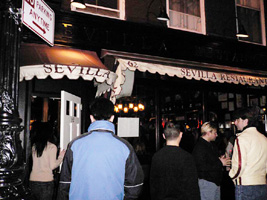
Around 7:00 PM, the patient came to the hotel to take me
a very nice Spanish food restaurant Sevilla. The restaurant
was very crowded and many people were waiting in front of
the restaurant. The main dishes in this restaurant were
several kinds of Paella. The taste was very good. After
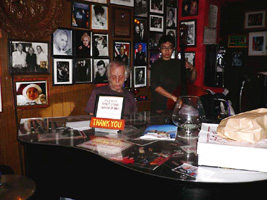
having dinner there, he took me several Jazz bars. One of
them is a very famous Jazz place. Actually, it is not a
Jazz bar but a Pizzeria. However, this Pizzeria has a grand
piano at the corner. Famous Japanese Jazz players, Terumasa
HINO and Sadao WATANABE, played Jazz in their young ages.
A young Japanese musician played Bass at that night. When
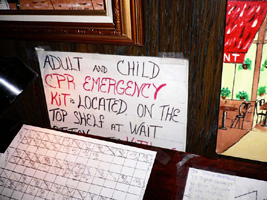
I went to a rest room, I was very surprised to see the signboard,
on which the place of the resuscitation kits was shown.
After leaving this Pizzeria, we moved to another Jazz bar,
Zinc Bar.
Next morning, I came back to Japan by flying an ANA flight
departing at 11 30 AM.
| |
|
Restaurant Sevilla |
A Japanese Musician
Playing Base |
| |
|
CPR Everywhere |
Entrance of Zinc
Bar |
米国訪問記III
湘南鎌倉総合病院 心臓センター循環器科
副院長・部長 齋藤 滋
はじめに
慢性完全閉塞(CTO)に対する冠動脈形成中は「PCIにおける最後の未開拓分野」とも呼ばれています。この分野では多くの日本人医師が仕事をしてきました。加藤 修先生、玉井秀男先生、鈴木孝彦先生、僕の友人光藤和明先生などです。私自身も2003年に、CCI誌に慢性完全閉塞に対するPCIの論文を掲載しました(Saito
S, Tanaka S, Hiroe Y, Miyashita Y, Takahashi S, Satake S,
Tanaka K. Angioplasty for Chronic Total Occlusion by Using
Tapered-Tip Guidewires. Catheter and Cardiovasc Interv 2003:
59; 305-11)。
近年、多くの外国人医師もCTOに対するPCIに関心を寄せるようになりました。心臓病学研究財団(CRF)というのは、Martin
Leon先生, Gregg Stone先生, Issam Moussa先生, Jeffrey Moses先生,
Antonio Colombo先生、そして他の有名な先生方によって米国に設立されていますが、昨年からCTOだけをテーマとした小さなライブデモンストレーションを開催し始めました。今年は、ニューヨークで2月4日と5日に開催され、私は術者および演者の一人として招聘されました。この学会の名前は第2回国際慢性完全閉塞サミットというもので、略してCTO
Summitと呼ばれます。ライブデモンストレーション症例はあのクリントン前大統領が冠動脈バイパス手術を受けたニューヨークのコロンビア大学病院から行われました。
2005年2月3日木曜日
2月3日の午前11時頃出発のJL006便でニューヨークに向かいました。John F
Kennedy国際空港までは12時間ぐらいの飛行です。時差が14時間ありますので、2月3日朝9時頃に空港に到着しました。しかし、入国審査用のコンピューター・システムがダウンしたため、入国するまでに1時間以上もかかりました。ケネディー国際空港はダウンタウンから40KMぐらい離れていて、しかも道路工事のために渋滞していましたので、会場でもあるGrand
Hyattホテルに到着したのは午前11時30分ぐらいになっていました。
Grand Hyattホテルの隣にはニューヨーク中央駅がありますが、その中に有名な「Oyster Bar」があります。日本にも品川駅に支店があるそうです。ホテルにチェック・インしてから私たちはこのレストランで昼食を摂りました。
飛行機の中ではほとんど寝ませんでしたので、とても眠くなり、部屋で2時間程寝ました。
ニューヨークにはCoppola先生やKwang先生といった友人の医師がSt Vincent病院にいます。私たちは去年の3月にここで小さなTRIのライブデモンストレーションを開催しました。ニューヨークの中では病院間の競争が激しく、特にPCIの分野ではとても激しいので、Coppola先生に率直に、コロンビア大学病院にCTO
Summitの期間中に行って症例を行う旨、予め伝えました。彼は、とても親切に分かって下さり、夕食を一緒に摂ることを約束しました。
私は、St Vincent病院近くのGonzoというイタリア料理店に夜6:30に行きました。既にCoppola先生達は我々の到着を待たれていました。とてもすばらしい夕食を皆で一緒に摂りました。
夕食を終えてから、日本人だけである有名な日本食麺の店に行きました。そこは、私の鎌倉での患者さんの奥様がきりもりされている店です。丁度その時、彼もニューヨークにおられましたので、お会いすることができました。彼は、土曜日にニューヨークに住んでいる人しか知らないような店に連れていって下さる、と言われました。
2005年2月4日金曜日
あいかわらずのひどい時差ぼけのため、午前4時に起床しました。「何故、Miracle/Magicガイドワイヤーを用いるのか」という講演の準備をしました。この講演はこの日の午前11時25分から予定されていました。朝の7時に、打ち合わせの部屋に下りていったのですが、案の定誰も部屋にいませんでしたので、ロビーのレストランで朝食を摂りました。そして、7:30に会場であるホテルの3階にある広間に行きました。
学会は朝7:45からStone先生の挨拶で始まりました。この後、とても教育的な講演がありました。会場はとても込み合っていました。会場に世界中の友人であるEulogio
Garcia先生, Fina Mauri先生, SJ Park先生, Runlin Gao先生、 Junbo Ge先生達がおられたのでとても驚きました。
ライブデモンストレーション放映は9時から始まりました。4人の術者がいて、その中には加藤先生と鈴木先生もおられました。加藤先生は右冠動脈のCTOを再開通させることに成功しました。鈴木先生は左冠動脈前下行枝近位部の固いCTOと4時間以上戦いましたが、残念ながらうまくいきませんでした。
| |
|
During the Meeting |
Dr KATO doing
a Case |
これらのライブデモンストレーションの後、私は自分の講演をそつなく終えました。もう昼ごはん時でありましたので、別の日本そばの店に行って昼食を摂りました。
午後もライブデモンストレーション放映があり、またCTOに対するニュー・ディバイスであるILT Safe-Cross
SystemやLuMend FrontRunner Catheterに関する講演がありました。
翌朝自分のライブデモンストレーションがありましたので、夕食を早めに摂ることに決め、その夜の夕食会には出席せずに寿司屋さんに行きました。寿司の後、ラーメンを食べに行きました。ニューヨークではラーメンが流行っているという話でしたので、とても期待していたのですが、がっかりでした。ラーメンはあまりにも流行りすぎて、既に日本食ではなくアメリカ食となっているのでしょう。
2005年2月5日土曜日
病院へ行くために午前7時に3階に降りるように言われていました。CRFがリムジンを用意していましたので、それに乗って病院に向かいました。土曜日であり、道はとても空いていましたので、コロンビア大学病院には20分ぐらいで到着しました。カテ室の入り口には歓迎の看板が出ていました。カテ室責任者はMoses先生です。何とカテ室が8室もあります。また、兵庫医大からの藤井先生など日本人の研究者が3人働いていました。
| |
|
Hospital Signboard |
| |
Hospital Building |
Welcoming Us |
この日の朝は、光藤和明先生、Raifart先生そして私が術者でした。2症例のCDが送られてきました。両方ともLCXの長いCTO症例でした。Mosesは私に「2例やってもらうけど、それでも良い?」と言いました。
米国ではFDA(米国食品薬品局)が認可したディバイス以外を用いることができません。ですから、使うことが出来たのは、Miracle
3 and 6, Confienza and Confienza-Pro (Conquest and Conquest-Pro),
Cross-it series そしてhydrophilic wiresのみでした。第一症例に対しては、7Fr
EBU 4.0, TransitそしてMiracle 3の組み合わせで開始しました。既に両側大腿動脈から7Frと5Frのシースが挿入されていました。Miracle
3はゆっくりとCTOの中を進んで行き、最後に硬い部分で止まりました。そこで、Conquest-Proを用いてdouble
guidewire techniqueを用いました。Moses先生が私の助手をされました。隣の部屋ではReifart先生が左冠動脈前下行枝の短いCTOに苦戦していました。Stone先生が助手でしたが、Stone先生は喋り続けました。このため、なかなかカメラが私たちの方に来ませんでした。Moses先生は明らかに苛立っていました。やっとカメラが来たので、何をしてきたかを説明しました。Double
guidewire techniquesをどのように行うかのとても良いデモでした。Leon先生がこの時座長をしていましたが、1999年に鎌倉からTCTにライブデモンストレーションを飛ばした時のことを皆に話されました。その時、TRIで左主幹部病変を持つ80歳の患者さんに対してロータブレーターとステント植え込みを行ったのでした。
Conquest-ProがLCX末梢にうまいこと通過しました。しかし、小さくないOMを失ってしまいました。ガイドワイヤーは真腔-偽腔-真腔と通過していたのです。IVUSを用いてOMの真腔を狙いましたがうまくいきませんでした。そこで、CypherをこのOMの前のCTO部分に植え込むことにしました。Cypherを植えて終了しました。きっと慢性期にはOMが開通していると思います。
光藤先生が別の部屋で右冠動脈のCTOと戦っていました。2時間半ぐらい頑張られたのですが、残念ながらうまく行きませんでした。
Moses先生が私の所に来て、次の症例に取り掛かりました。既にライブデモンストレーション放映は終わっていました。先と同じシステムで開始しました。しかし、閉塞の近位部で動脈はひどく蛇行し、しかも閉塞の入り口は石灰化し、非常に硬かったので、私は30分ぐらいで中止しました。カテ室を去る前に光藤先生と記念の写真を撮りましたが、残念ながらピントが合っていません。
私は自分の結果に半分満足でした。
ホテルに帰る前に、一番有名なラーメン屋さんに行きました。でも、やはり失望してホテルに戻りました。ホテルの近くの散髪屋さんで髪を切り、それから2時間部屋で寝ました。
夜の7時頃になって、患者さんが私を連れにホテルに来られました。そして、とても良いセビリアというスペイン料理の店に行きました。この店はとても混んでいて、店の前で行列が出来ていました。主なメニューはパエリアですが、とてもおいしいものでした。夕食の後、彼にジャズの場所に連れて行って頂きました。この内の一つは、実はピザ屋さんなのですが、店の一角にピアノが置いてあり、そこでジャズをしていました。日野てるまさや渡辺貞夫などの有名なジャズ音楽者もここで若い頃仕事をしていました。今も、若い日本の音楽家がベースを弾いていました。トイレに行こうとすると、そこには救命セットの置き場所を記した看板があって驚きました。この店を出て、次のジャズ・バーにいきました。
翌朝、全日空の便で日本に戻りました。
| |
|
Restaurant Sevilla |
A Japanese Musician
Playing Base |
| |
|
CPR Everywhere |
Entrance of Zinc
Bar |
|