Visiting Kuala Lumpur -IVShigeru Saito, MD, FACC, FSCAI, FJCC
|
|
|
|
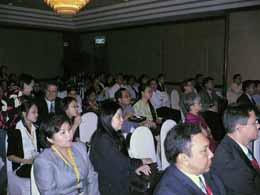
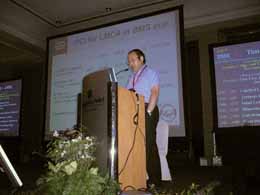
I had another lecture on left main stenting during the Lunch-Time Session from 13:30 to 13:45. After finishing the session, I moved to the National Heart Institute (Institut Jantung Negara: IJN) with Dr. Ian Meredith from Melbourne. We reached the hospital around 3:30 PM. I did not know what kind of case I would do. Dr. Rosli Mohd Ali told me, “We arrange a very easy case for you. It is the case, which I failed in reanalyzing the CTO lesion in LAD.” In the catheter laboratory, I saw the case CD. The patient was a 56-years old gentleman, who had previous CYPHER stent implantation in the distal RCA 3 years ago. He presented to the hospital with effort angina for more than 6 months. Dr. Rosli tried to open the long CTO lesion in the proximal LAD on May 26th, 2006, although it was failed with severe dissection, big false lumen formation and small perforation. Dr. Ian Meredith was originally supposed to do PTSMA live transmission. However, his case was cancelled and rescheduled to assist me.
I started with bi-femoral puncture. I placed 7- and 8-French introducers, and a 7-Fr AL1.0SH 90-CM and 8-Fr XB4.0SH guiding catheters from the right and left femoral arteries, respectively. Since the antegrade approach seemed too difficult after the creation of big dissection, I started from the retrograde approach by using a combination of a Finecross and a Fielder guidewire. The X-ray machine was Toshiba, and its image was not good. The stent previously placed in the RCA was difficult to see. After the guidewire crossed the stent, I crossed the Finecross through the stent. However, since the guidewire was going in the different branch, I had to pull back the Finecross a little. However, I was upset to know the microcatheter tip was completely trapped by the stent. Ian was continuously talking something about the strategy. I tried to pull out the guidewire and microcatheter together. After several attempts, I could do it. However, the tip of the microcatheter was left in the stent. I could clearly see the distal marker of the microcatheter remaining in the stent. After disclosing what happened to the audience, I restarted the procedure with a combination of Fielder and Transit microcatheter. The collateral septal branches were dividing from a PD branch. However, the stent was overhanging from the proximal RCA to the AV branch. Thus, the stent was obstructing. After I passed the guidewire into a septal branch, I exchanged the microcatheter to a 1.25-mm OTW Ryujin balloon and dilated the stent strut. After this stent dilatation, everything got easier. And also happy for me! The distal marker of the Finecross left in the stent was spontaneously washed away into a very distal small branch of RCA. Now, the remaining fragment would not do any harm to the patient.
While manipulating the guidewire, the patient complained of chest pain, his EKG showed marked ST depression, and blood pressure decreased. By angiography, we identified that coronary arteries showed severe spasm. After nitroglycerine injection, the situation improved. The 1st septal route was not good, because the distal end of the septal branch was going to the distal LAD. I could not navigate guidewires to the proximal LAD. While doing these attempts, Ian left the catheter laboratory, since his flight was departing at 8:30 PM. This made a working space and free decision for me. Everything became easier for me.
|
|
|
|
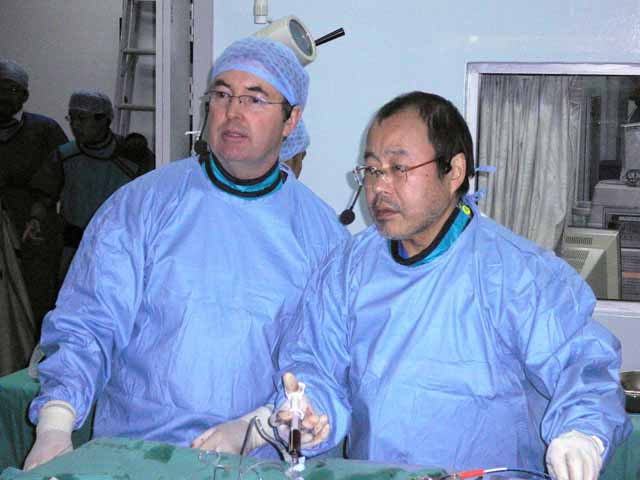
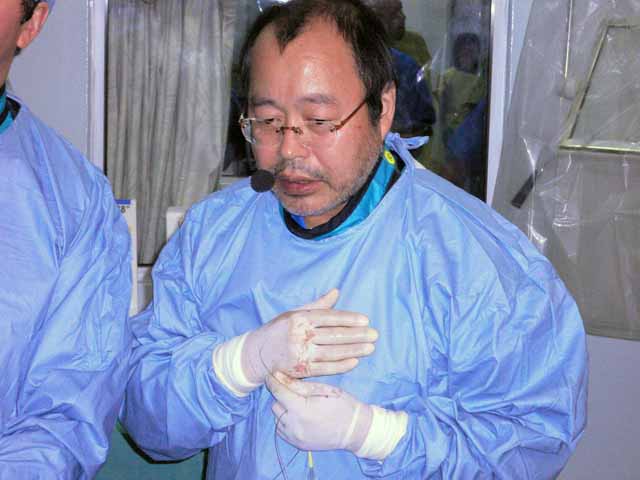
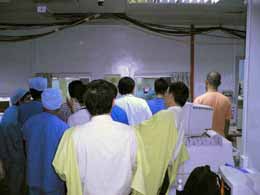
I changed the septal branch to the more distal one. Finally, I could get a good septal route. After pushing the OTW balloon into the LAD, I exchanged the guidewire to Miracle 3 and 6 guidewires. At this moment, I started the antegrade approach by using a combination of Transit and Miracle 3 guidewire, which was finally replaced by a Conquest-Pro 12 guidewire. After the retrograde balloon dilatation with a 2.5-mm OTW Voyager balloon, I could successfully cross the antegrade Conquest-Pro 12 guidewire to the distal true lumen of LAD. It was almost 6:00 PM, when the transmission was cut off. After the successful wire crossing, I placed a 3.0x33 mm and a 3.5x33mm CYPHER stents from the ostium of LAD. The final result was fantastic. Everybody made a thunder of applause. Dr. Ochiai already finished his case successfully by doing the retrograde approach for the first-attempt proximal RCA CTO lesion. He came to me and congratulated the success of us.
|
|
|
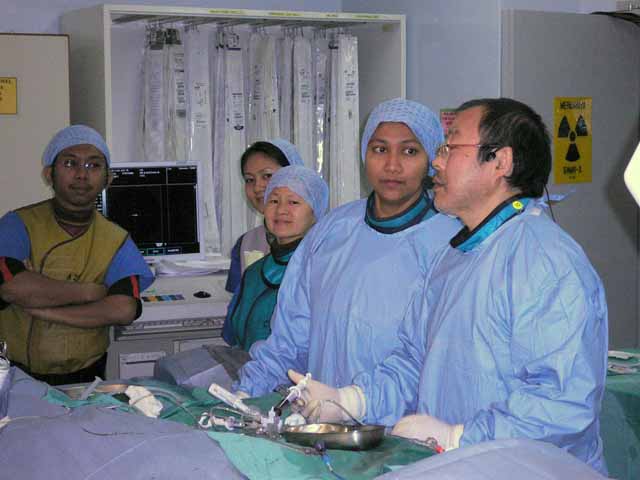
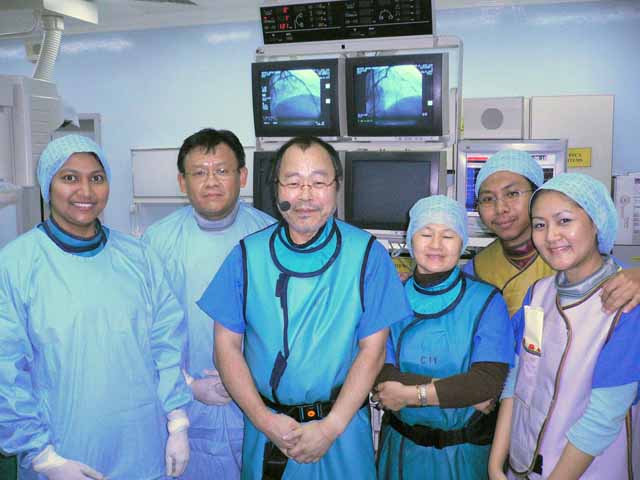
After having dinner in Japanese Restaurant “Zipang” within the Shangri-La Hotel, I returned to Japan by taking the overnight flight, and arrived at Narita Airport around 7:30 AM on July 15th Saturday 2006. This trip was very short but interesting and fruitful.
クアラルンプール訪問記 - IV
湘南鎌倉総合病院 心臓センター循環器科
齋藤 滋
私はクアラルンプールのシャングリラ・ホテルで2006年7月12日から15日まで開催され た第三回マレーシア・ライブデモンストレーションにファカルティーとして招聘されました。今 年は日本から岸和田の横井先生、福岡の上野先生、川崎の村松先生、横浜の落合先生そして私の 5名がファカルティーとして招聘されました。また、たくさんの有名な医師が世界中から招聘さ れていました。
成田空港から7月13日木曜日の便でKLに飛び、ホテルに入ったのはその日の19:00頃で した。
2006年7月14日金曜日
”Japanese CTO Club”というBreakfast Symposiumが7:00 AMより開催されました。私と 落合先生がそれぞれ15分ずつの講義を2つずつ行いました。会場は満杯でした。アメリカの Kandazari先生が座長を行い、シンガポールのArthur Tan先生達がモデレーターをされました。
|
|
|
Lunch-Time Sessionでも13:30-13:45まで左主幹部ステンティングについての講義があり ました。その後、国立心臓病センタ-(IJN)にメルボルンのDr. Ian Meredithと共に車で移動し ました。病院には3:30 PM頃に到着しました。どのような症例を行うのか知りませんでした。 Rosli先生が私に、「簡単な症例用意したから、僕が一度してうまくいかなかったLADのCTO だよ」と言いました。カテ室でCDを見ました。患者さんは56歳男性で、3年前に右冠動脈に 対してCYPHERが植え込まれています。患者さんは半年以上前から労作性狭心症があり、今年 の5月26日にRosliがLAD近位部の長いCTOに対してPCIを試みましたが、激しい解離、 大きな解離腔そして一部動脈穿孔を残して終了しました。Ianはもともと他の患者さんに対して PTSMAを行う予定でしたが、その患者さんがキャンセルとなり、私の助手をすることになりま した。
まず、7Fr, 8Frのシースそして、7Fr AL1.0SH 90CMと8Fr EX4.0をそれぞれ右および左 大腿動脈より挿入しました。順行性アプローチは激しい解離のためほとんど不可能と思えました ので、最初から逆行性アプローチを行うことに決めました。FinecrossとFielderを用いました。 レントゲン機械は東芝でしたが、イメージはあまり良くありませんでした。以前に右冠動脈に植 え込まれたCYPHERも良く見えませんでした。ガイドワイヤーがステントをクロスしてから、 Finecrossでステントをクロスしました。しかし、ガイドワイヤーは別の枝にいっていましたの で、Finecrossを少し抜こうとしました。しかし、何とFinecrossがステントにトラップされて 動かないのです。とっても焦りました。Ianは横で戦略について喋り続けでした。私は、ガイド ワイヤーと一緒にして抜去を試みました。やっとのことで抜去できましたが、Finecrossの先端 はビローッと伸び、先端マーカー部分はステント内に残ってしまいました。ライブデモンストレ ーションを見ている皆に何が起こったのか説明してから、FielderとTransitで再開しました。 副血行の中隔枝はPDから分岐していました。ステントが何と右冠動脈近位部からAVにかけて 植え込まれていることが分かりました。従ってステントが経路を塞いでいるのです。ガイドワイ ヤーを中隔枝に通した後、Transitを1.25mm OTW Ryjuinに交換し、まずステント・ストラッ トを拡張しました。これによって、スイスイと通るようになりました。更に良いことには、ステ ントにトラップされていたFinecrossのマーカー部分が右冠動脈末梢の小さな枝に流れていき ひっかかりました。それでもう大丈夫です。
ガイドワイヤーを操作していると、患者さんが胸痛を訴え、心電図はST低下を示し、血 圧が低下しました。造影すると冠動脈はひどいスパスムでした。ニトロを投与することによって、 改善しました。手前の中隔枝は良くありませんでした。LADに合流する部分でLAD遠位を向 き、いくらやってもガイドワイヤーをLAD近位に向けることができませんでした。ここまでや っている間にIanが飛行機の時間があるのでカテ室を去りました。Ianが去ってから正直、色々 とやりやすくなりました。まずは立つ位置を確保でき、また自由に決断できるようになりました。
|
|
|
|
もう少し遠位の中隔枝を選択するようにしました。最終的に良い中隔枝を選択することが できました。LADにOTWバルーンを押し込んでから、ガイドワイヤーをMiracle 3と6に変 更しました。こごてTrasit + Miracle 3を用いて順行性アプローチを開始しました。このガイド ワイヤーは最終的にConquest-Pro 12に交換しました。逆行性に2.5-mm OTW Voyagerを拡張 すると、順行性のConquest-Pro 12はLADの真腔に容易に通過しました。この時点で既に放映 終了の18:00間近でした。最後に、CYPHER 3.0x33mm + 3.5x33mmをLAD入口部から植え 込んで終了しました。皆が拍手喝采しました。落合先生は既に初回トライの右冠動脈CTOを逆 行性に行い終了していました。彼も入ってきて成功を祝って下さいました。
|
|
|
シャングリラ・ホテルの日本料理店”Zipang”で夕食を摂ってから、日本帰る夜行便に乗り ました。そして翌日7月15日土曜日の7:30 AM頃に帰国しました。今回の旅もとても短いもの でしたが、盛りだくさんでした。