Visiting Korea XIIIShigeru Saito, MD, FACC, FSCAI, FJCC
|
|
|
|
January 6th Saturday 2007
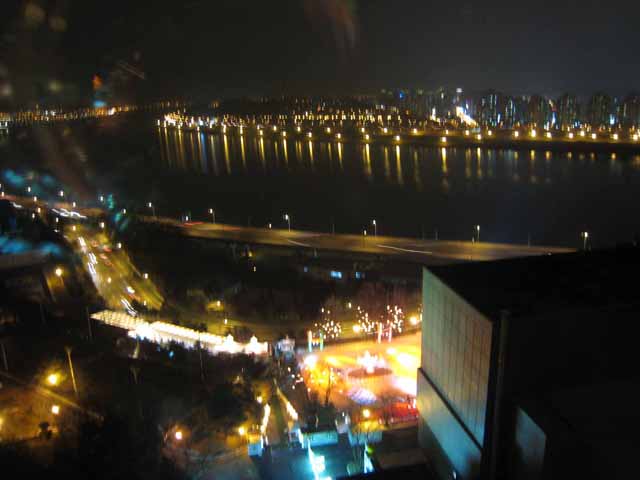
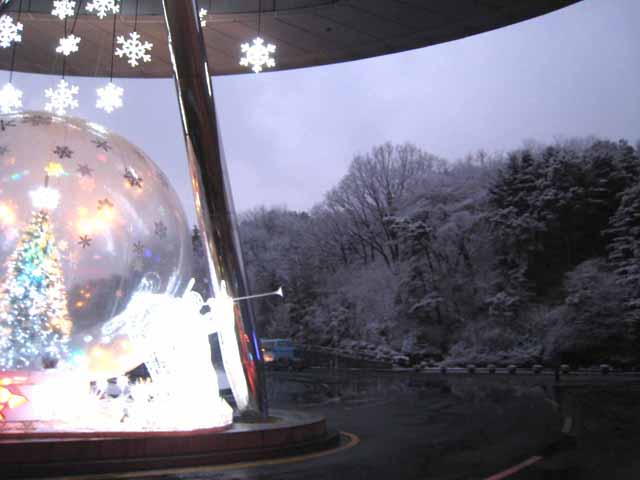
I waked up at 6:15 AM. It was snowing outside. After having breakfast in the hotel, I moved to Asan Medical Center, which is located at the opposite side of the Han River with the hotel.
The case conference started from 8:00 AM in a conference room next to the catheter laboratories. Angiograms of the all candidate patients were shown to the operators first that time. Any operators did not choose their own cases. Every operator followed the decision made by Dr. Park. The case no. 1 and no. 5 were assigned to me. Both cases seemed not easy. However, I accepted those cases. Anyway, I can do only what I can do but try to do all what I can do. That is my principle.
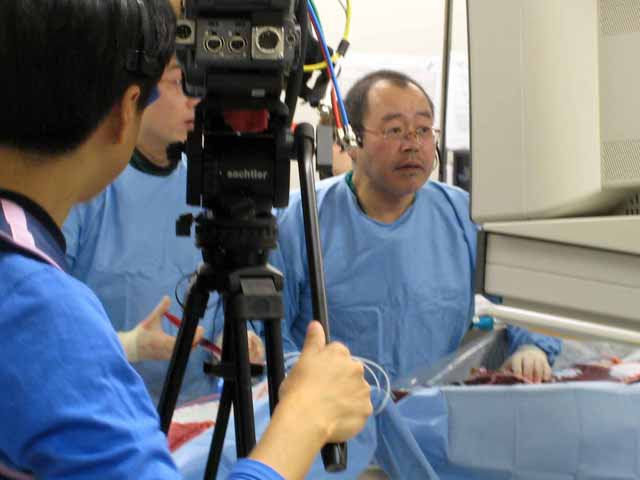
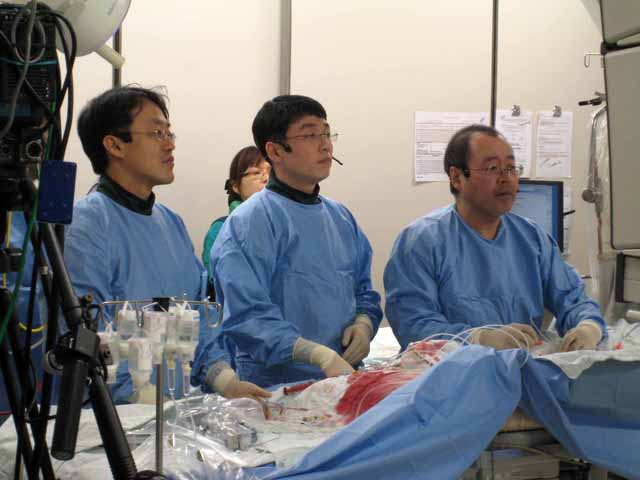
The 1st case was a 60++ years old male patient with a proximal LAD occlusion with heavy calcification. He had anterior myocardial infarction in the year of 2000. The stump was not clear. Previous attempt done several months ago was failed. I started the case from 8:50 AM by putting two 7-French long sheaths from both femoral arteries. My initial plan was to do the retrograde approach from RCA through the septal branches. The transmission was started from 9:00 AM with the brief opening speech by Dr. Park. By using the combination of Finecross and Fielder guidewire, I reached LAD retrogradely. However, because the septal branch meets with LAD close to the distal end of the CTO lesion, I could not navigate a Miracle 3 guidewire into the CTO lesion itself. I tried to search any other septal branch route. However, I just spent time. Thus, I decided to give up the retrograde approach and to switch to the antegrade approach.
Since the entry point of the CTO lesion was not clear, first I did IVUS to the 1st diagonal branch. The entry point seemed just at the bifurcation with the diagonal branch. I started with the combination of Finecross and a Mircle-3 guidewire. However, the lesion was so hard. I exchanged the wire to a Miracle-12. Again, I could not make any advancement. Then, I took a Conquest-Pro 12 to break the proximal hard plaque. Gradually, the guidewire moved forward and finally went into the false lumen. I again took the Miracle-12 guidewire, which went into the different direction and then into the false lumen. While keeping the Miracle-12 in the false lumen. I took the Conquest-Pro 12 guidewire, which went into another false lumen. Already I spent 90 minutes for procedure time and 600 cc of contrast dye. As the final attempt, I took the 3rd guidewire, which was another Conquest-Pro 12. I carefully manipulated the wire, and then finally I got the distal true lumen. At the end of the procedures, I placed a 3.0 x 24mm and a 4.0 x 24mm Endeavor DES stents. The final result was fantastic. Everybody congratulated me. I was very happy for this success after difficult struggling.
The 2nd case had a CTO lesion in the middle LCX. Distal vessel was collateralized from the diagonal branch. I put two 7-French guiding catheters into the left coronary artery. I first started from the retrograde approach through the faint connection between the diagonal branch and the distal LCX. However, the connection was too faint and too much tortuous to cross a Fielder guidewire through. Again, I abandoned the retrograde approach and moved to the antegrade approach. By the combination of a Finecross and a Miracle3 guidewire, I could cross the occlusion with not so much difficulty. After placing a stent, the result looked wonderful.
|
|
|
|
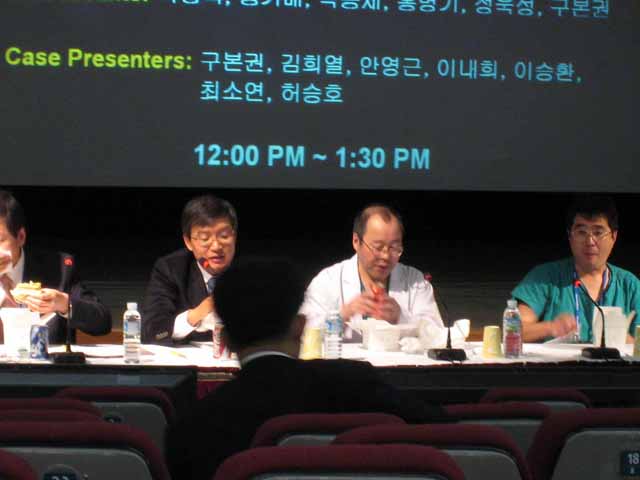
I moved to the auditorium to moderate the lunch time case presentations. There were several Korean physicians presenting their own cases. While hearing their case presentations, I really understood that many Korean physicians had already caught up the specialized advanced techniques for CTO, which had been developed by Japanese physicians. I have to keep devoting myself to PCI for CTO. After the lunch time session, there were other live transmissions by Dr. Asakura and Dr. Tsuchikane. I moderated their live transmissions.
I was very happy to be successful in my 2 cases. Also, I was very happy to see Dr. SJ Park. Since I had to hurry to the Incheon International Airport to catch the last flight to Beijing, I left the hospital. By taking the China Eastern Airline CZ 316 flight, I arrived in Beijing Capital Airport around 21:30 on January 6th Saturday 2007.
韓国訪問記 - XIII
湘南鎌倉総合病院 心臓センター循環器科
齋藤 滋
画像をクリニックすると大きくなるかも知れません
9ヶ月ぶりの韓国
驚くべきことに、この前韓国を訪れたのは2006年4月終わりのことでした。従いまし て、9ヶ月ぶりの訪問ということになります。今回は、CVRF主催のCTO Live 2007に招 聘術者としてPark先生より招聘されました。この会は、12月になって急に開催が決まっ たものです。韓国でも慢性完全閉塞に対するPCIへの興味が急速に増加しています。
このコースはとてもユニークなものでした。一つとして講演は無く、日本人の4人の 術者によるライブ手技のみのコースでした。術者としては、鈴木孝彦先生、土金先生、朝 倉先生そして私でした。韓国の先生方は、術者の助手あるいは、ライブ中継のモデレータ ーの役割をこなされました。全てがAsan Medical Centerの中で開かれました。聴衆は病 病院6階にある大講堂に集まり、3階のカテ室から中継が飛ばされました。
羽田空港から2007年1月5日金曜日13:00発のアシアナ航空OZ 1015便で金浦空港 に飛びました。Sheraton Walker Hillホテルにチェックインしてから部屋で休みました。 ホテルは漢江(ハンガン)沿いに建っています。Park先生主催の身内のみの夕食が8:00 PM からホテル内の日本食レストランで開催されました。4人の日本人医師は皆集まりました。 何と、Park先生とは1年以上も顔を合わせていませんでした。再会してとても良かったで す。夕食はとても楽しく、皆たくさんお酒を飲みました。
|
|
|
2007年1月06日土曜日
6:15 AMに起床しました。外は雪でした。ホテルで朝食を摂ってから、Asan Medical Centerに移動しました。ハンガンを挟んで向かい側にあります。
症例検討会が8:00 AMからカテ室脇のカンファランス・ルームで開かれました。この 時初めて症例のアンギオが術者に呈示されました。術者は誰も「これがいい」とか「あれ がいい」とか言いませんでした。皆、Park先生の指示に従いました。No. 1とNo. 5の症 例が僕に割り当てられました。両方とも簡単な症例とは思えませんでした。でも、受け入 れました。どっちにしたって、自分ができることしか出来ないし、自分の出来ることを全 力でるだけさ。それが私の信念です。
1例目の患者さんは60歳台の男性でした。左前下行枝近位部が強い石灰化と共に完全 閉塞していました。2000年に前壁梗塞となったということでした。断端がどこか、はっき りしませんでした。数ヶ月前に一度PCIが試みられましたが不成功に終わったのです。8:30 AMからスタートし、両側大腿動脈よりロング・シースを挿入し、7Frのガイドカテを2本 挿入しました。最初の戦略はRCAから中隔枝を介して逆行性アプローチをすることでした。 中継が9:00 AMからPark先生の開会の言葉に続いて始まりました。FinecrossとFielder を用いて逆行性に左前下行枝にまで到達しました。しかし、中隔枝がCTO病変遠位端のす ぐ近くで左前下行枝に合流していたため、Miracle 3ガイドワイヤーをCTOの中に導入す ることができませんでした。他の中隔枝も探しましたが時間を潰すだけで駄目でした。そ こで、逆行性アプローチは諦め、順行性アプローチにすることにしました。
CTOのエントリーがはっきりしませんでしたので、まずIVUSを第一対角枝向きに行 いました。エントリーは対角枝分岐部の部分のようでした。FinecrossとMiracle 3ガイド ワイヤーで開始しました。でも、病変はとても硬かったのです。そこでガイドワイヤーを Miracle 12に交換しました。でも、それでもガイドワイヤーは少しも進みませんでした。 そこで、手前の硬いプラークを破るためにConquest-Pro 12に交換しました。徐々にガイ ドワイヤーは前に進みましたが、偽腔に入りました。そこで、Miracle 12に交換しました。 今度はMiracle 12は別の方向に進み、偽腔に入りました。Miracle 12を偽腔に置きながら、 Conquest-Pro 12を取りました。これは別の偽腔に入りました。既に90分間手技を行い、 造影剤も600 ml使っていました。最後の試みとして、3番目のガイドワイヤーとして Conquest-Pro 12を取りました。そして、このガイドワイヤーを慎重に操作しました。その して、ついに真腔を捉えました。最終的に3.0 x 24mmと4.0 x 24mmのEndeavor DES ステントを植え込みました。最終結果はとてもすばらしいものでした。皆、私を絶賛しま した。この困難な手技を終え、とても幸せでした。
2例目は左回旋枝中部にCTO病変がありました。末梢は対角枝からの副血行で潅流さ れていました。まず、7 Frのガイドカテを2本 左冠動脈に入れました。まずは、対角枝 と回旋枝末梢をつなぐ微かな副血行路を用いた逆行性アプローチで開始しました。しかし ながら、この繋がりはとても微かであり、また蛇行がひどかったので、Fielderガイドワイ ヤーを通過することができませんでした。またもや逆行性アプローチを諦めて、順行性ア プローチに変更さざるを得ませんでした。FinecrossとMiracle 3によってこの閉塞をそん なに難しくなくクロスすることができました。ステントを入れた後の結果はすばらしいも のでした。
|
|
|
|
ランチョン・セッションの症例呈示を司会コメントするために講堂に向かいました。数 名の韓国の先生が症例呈示されました。この症例呈示を拝見して、韓国の先生方は日本人 が開発してきた高度なCTOに対するPCIテクニックを既に習得されている、ということを 知りました。自分ももっとかんばらねば、と思いました。ランチョン・セッションに引き 続いて朝倉先生と土金先生の手技の中継が行われ、私はそのコメンテーターをしました。
でも私の2例がうまくいって幸せでした。また、Park先生にお会いできたことも嬉し いことでした。北京行き最終便に乗るためにインチョン国際空港に急がねばなりませんで したので、病院を去りました。中国東方航空CZ 316便で北京国際空港に到着したのは、2007 年1月6日土曜日の21:30頃でした。